
Why 3D Animation Is Becoming Essential for Modern Businesses
Why Businesses Are Moving Beyond Static Visuals

A product photo can show what something looks like. It can't show how it works, what it feels like to use, or what happens inside it. That gap is exactly where a growing number of businesses are turning to 3D animation instead of investing further in static imagery.
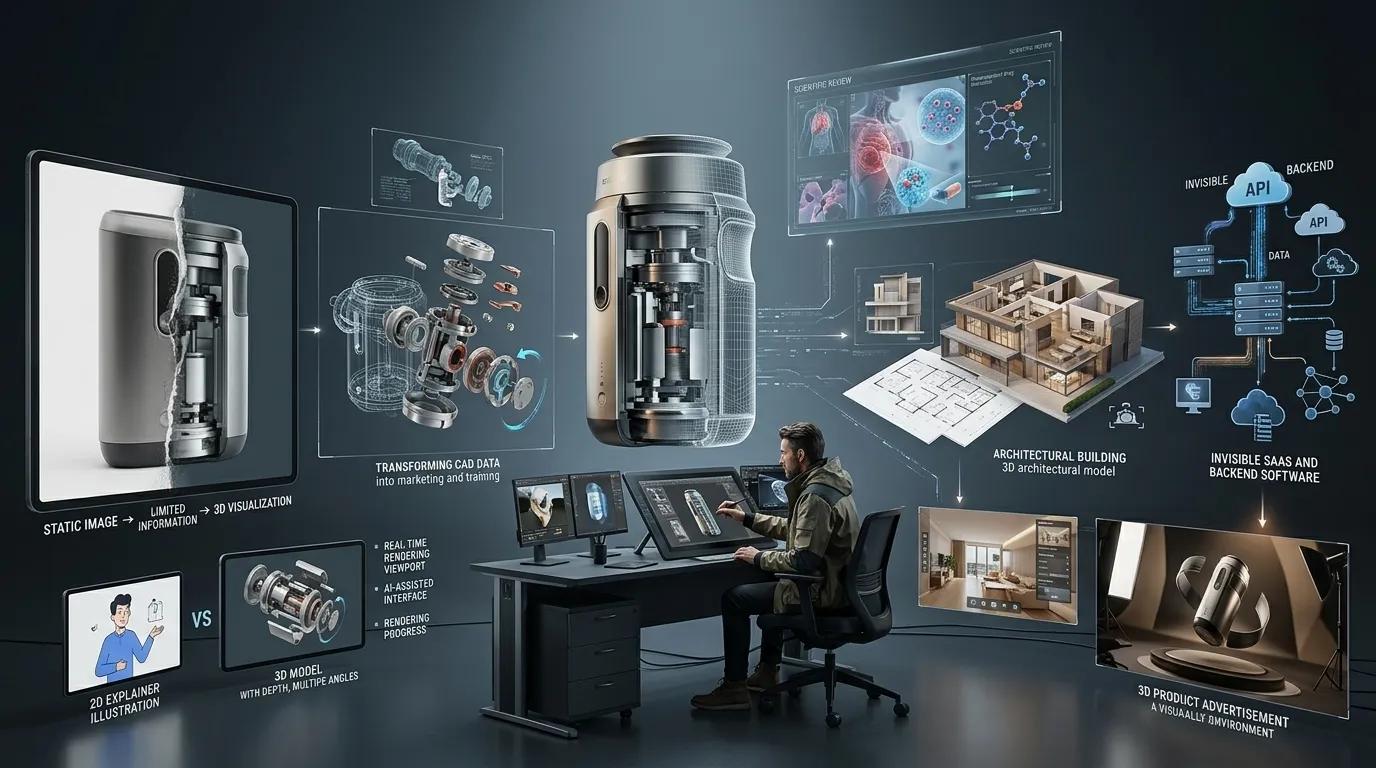
The shift isn't really about aesthetics. A software company can't photograph a workflow. A manufacturer can't photograph a mechanism moving inside a sealed housing. A hospital can't photograph a drug interacting with a cell. Static visuals hit a wall the moment the thing you're explaining involves motion, internal structure, or a process unfolding over time — and that's precisely the category of communication problem 3D animation was built to solve.
The Growth of 3D Animation
3D holds the largest share of the animation market by product type across every major industry report, though the exact figure depends on how each research firm defines the category — estimates range from roughly 44% up to nearly 58% of total market share. That range reflects differences in methodology rather than disagreement about the underlying trend: 3D work is commanding a growing share of both entertainment and business animation spend, and it typically carries a higher average production budget than 2D or motion graphics work.
The reason 3D keeps expanding its share comes down to what it can show that no other format can. It can render the inside of a machine, a molecule, or a building that doesn't exist yet, which makes it the default choice whenever a business needs to visualize something real-world cameras simply can't capture. For the full breakdown of how these figures are calculated across research firms, Pixel Studios' 3D animation market trends research covers the methodology behind each estimate.
3D Product Visualization
Before a product exists physically, 3D animation lets a business show it anyway. Marketing teams use rendered product visualizations to launch campaigns before manufacturing finishes a single unit. Sales teams use them to demo features, rotate a product on screen, or show an assembly process that would be impractical to film.
This matters most for products with moving parts, internal components, or variations that would be expensive to physically photograph in every configuration. A single 3D asset can be re-rendered in different colors, materials, or configurations without a new photo shoot for each variant.
Manufacturing and Industrial Applications
Manufacturing is one of the fastest-growing segments in the animation market, and the driver is practical: manufacturers already have detailed CAD data sitting in engineering files. Converting that data into finished animation is far more efficient than building visual content from scratch.
That same CAD-to-animation pipeline feeds product visualization for marketing, training content for factory floor employees, and virtual prototyping that lets a company demonstrate a machine before it's physically built. For industrial businesses, 3D animation has become less a marketing expense and more a way to compress the gap between engineering and market.
Medical and Healthcare Visualization
Medical animation is growing at approximately 13.4% annually, driven by pharmaceutical companies, device manufacturers, and healthcare systems that need to explain things patients and clinicians can't otherwise see: how a drug interacts with the body, how a device functions inside it, or how a surgical procedure should be performed.
Unlike most commercial 3D work, medical animation typically goes through a dedicated scientific accuracy review before it ships. Visual polish matters, but in this category it's secondary to getting the underlying mechanism exactly right.
Architecture and Real Estate
3D animation lets architecture and real estate businesses sell a space before it's built. Walkthroughs, flythroughs, and rendered interiors give buyers and investors a sense of a finished building years before construction completes, which has become a standard part of pre-sale marketing for larger developments.
Real-time rendering technology, adapted from gaming, has also made interactive walkthroughs increasingly affordable, letting a prospective buyer navigate a rendered space themselves rather than watching a fixed video.
SaaS and Technology Products
Software is inherently difficult to visualize, since most of what a SaaS product actually does happens on a server, not on screen. 3D animation gives technology companies a way to represent abstract processes, like data moving through a system or a backend workflow, in a form an audience can actually follow.
This has become particularly common in enterprise software marketing, where the buyer needs to understand a complex integration or architecture before a sales conversation even starts.
3D Animation in Advertising
Advertisers have adopted 3D animation for the same reason product companies have: it can render things that would be impossible, expensive, or impractical to film. A product can be shown from angles no camera rig could reach, in environments that don't exist, at a scale no physical set could achieve.
Motion graphics and animated creative also consistently outperform static ad formats on engagement and completion rate, which has pushed 3D further into mainstream advertising budgets rather than staying a niche, big-budget technique.
3D vs 2D: When Should Businesses Choose Each?
3D and 2D solve different problems, and the choice should follow the communication goal rather than trend or budget alone. 3D is the stronger choice when a business needs to show depth, internal structure, physical accuracy, or a product that needs to be viewed from multiple angles. It suits manufacturing, medical, architecture, and product visualization work where realism and spatial accuracy carry real weight.
2D tends to be the better fit for explainer content, brand storytelling, and situations where a simpler, faster, more stylized visual communicates the message just as effectively, often at a lower production cost and shorter timeline. Neither format is inherently superior; the right one depends entirely on what the audience needs to understand.
What the Future Looks Like for 3D
Real-time rendering, AI-assisted production tools, and cheaper computing power are steadily lowering the cost of entry for 3D animation, which is pulling it further into industries that couldn't previously justify the budget. Manufacturing, healthcare, and SaaS are likely to keep growing as a share of total 3D animation demand, alongside the entertainment and gaming work that built the technology in the first place.
For businesses evaluating whether 3D animation is worth the investment, the more useful question isn't whether the format is trending. It's whether the audience needs to understand something that a photo or a written description simply can't convey. Where that's true, 3D increasingly isn't a nice-to-have. It's becoming the default.