
Corporate Animation Services: 2D vs. 3D Animation
Corporate video budgets keep growing, but most marketing teams still can't answer one basic question: should this project use 2D animation services or 3D animation services? Get that call wrong and you end up with a video that goes over budget, misses the deadline, or simply doesn't hold anyone's attention past the first ten seconds.
This guide covers what corporate animation actually includes, how 2D and 3D animation differ in practice, what a professional production process looks like, and the mistakes that quietly waste a video budget. By the end, you'll know which type of animation fits your goals, your audience, and your budget.
What Are Corporate Animation Services?
Corporate animation services are professional video production services that use illustrated (2D) or dimensional (3D) animation to explain a company's product, process, or brand story. They cover explainer videos, motion graphics, whiteboard videos, logo animation, and internal training content, and they're built for business goals like lead generation, product education, and employee onboarding rather than entertainment.
Unlike live-action video, animation doesn't need actors, locations, or reshoots. A script change is a design change, not a new shoot day, which is why so many B2B and enterprise teams default to animation for anything technical or abstract.
2D Animation Services vs. 3D Animation Services
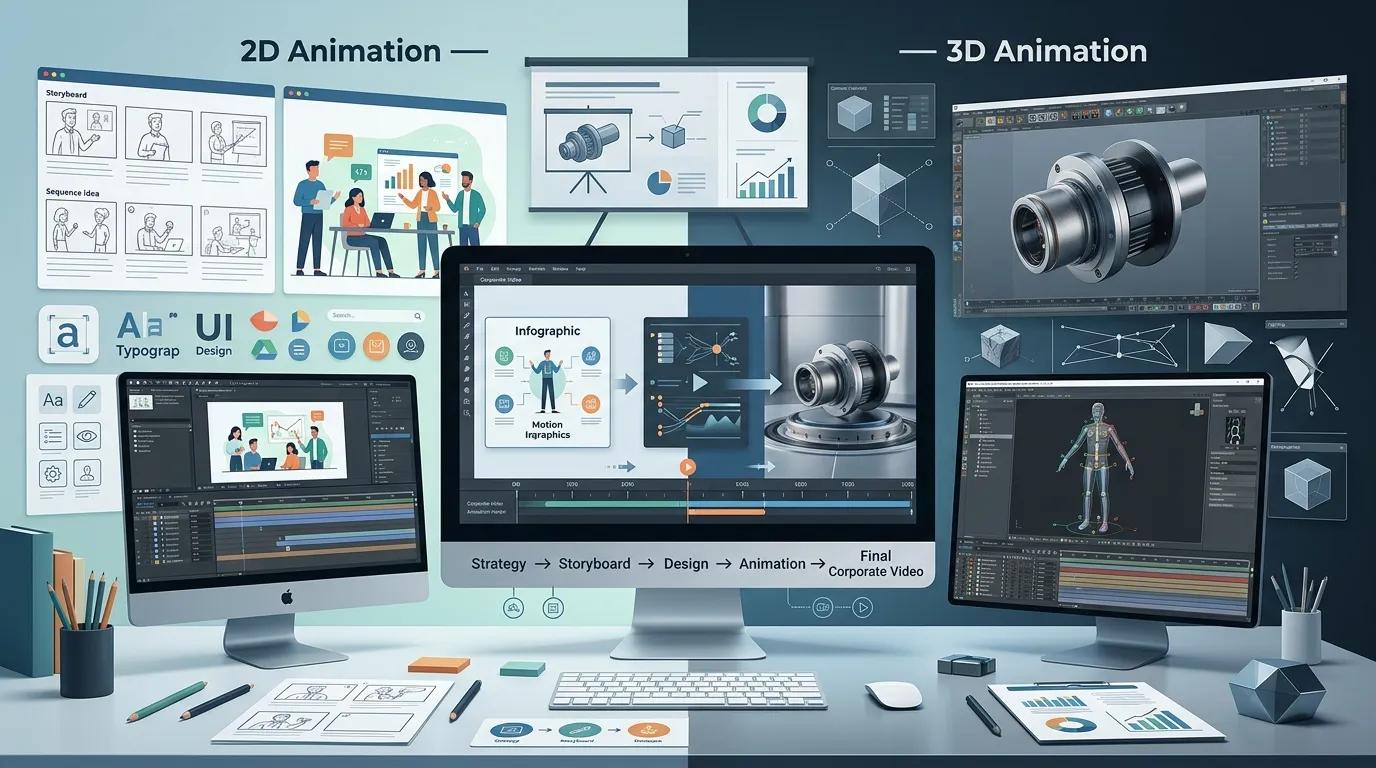
The two formats solve different problems. 2D animation services work best when you need to explain an idea quickly and affordably. 3D animation services work best when the audience needs to see how something physically looks, moves, or fits together.
Factor | 2D Animation Services | 3D Animation Services |
Visual style | Flat, illustrated, stylized | Realistic, dimensional, physical |
Typical budget | Lower to mid-range | Mid to high-range |
Production timeline | Faster turnaround | Longer, more technical build |
Best for | Explainers, onboarding, whiteboard videos, app walkthroughs | Product visualization, manufacturing, architecture, medical devices |
Common industries | SaaS, finance, healthcare education, e-commerce | Industrial equipment, real estate, automotive, pharma |
Why Corporate Animation Matters Right Now
Video has stopped being optional in B2B marketing, and animation has carved out a specific role inside that shift. Recent industry research points to a few numbers worth planning around:
• 91% of businesses now use video as a marketing tool, and 82% report a strong return on that investment, according to 2026 research from Growth Navigate.
• 85% of consumers say they've bought a product after watching a video about it, per the same 2026 report.
• Roughly a quarter of video marketers now produce animated content specifically, according to Vidico's 2026 video marketing data, making it one of the more effective ways for a brand to stand out in a feed dominated by live-action clips.
• Explainer videos, most of which are animated, are the single most-used video format among marketers surveyed in 2026, cited by close to three-quarters of respondents in industry research from Wyzowl and Dash.
• Production costs have come down: 2026 data from Digital Applied shows the median cost per finished video minute has dropped from roughly $4,200 to $2,500 as production workflows have matured, making professional animation realistic for more company budgets.
The takeaway: animation is no longer a niche creative choice. It's a standard line item in corporate marketing and training budgets, and the businesses seeing the best return are the ones matching the right animation style to the right message.
Types of Corporate Animation Projects
• Explainer videos — short videos that walk viewers through a product, service, or concept
• Motion graphics — animated text, icons, and data used in presentations, ads, and social content
• Whiteboard videos — hand-drawn style animation often used for education and training
• Logo animation — a short animated version of a brand's logo for intros and outros
• Onboarding and training videos — internal content that explains processes or software to employees
• Product demo animation — a visual walkthrough of how a product or system works
How to Choose Between 2D and 3D Animation
Choose 2D Animation Services When...
• You're explaining a concept, workflow, or piece of software
• Budget and turnaround time are tight
• Your brand has a strong illustrated visual identity already
• The content is aimed at social media or a landing page
Choose 3D Animation Services When...
• You're showing a physical product, machine, or piece of equipment
• Viewers need to understand scale, depth, or how parts move together
• You're producing architectural walkthroughs or medical or industrial visualizations
• The video needs to look photorealistic or highly polished
The Corporate Animation Production Process
A professional animation studio typically works through six stages:
1. Discovery and strategy — defining the audience, goal, and key message
2. Scriptwriting — turning the message into a tight, conversational script
3. Storyboarding — mapping out each scene before any animation begins
4. Style frames and design — locking the visual look, characters, and color palette
5. Animation and sound — building motion, voiceover, music, and sound effects
6. Revisions and delivery — client review rounds and final files in the formats you need
Skipping the storyboard or style-frame stage is the most common way projects go over budget, since changes made after animation begins cost far more than changes made on paper.
Common Mistakes Businesses Make
• Choosing 3D animation for a message that only needed a simple 2D explainer, and paying for complexity nobody notices
• Writing a script before defining the target audience, which produces generic, unfocused messaging
• Skipping storyboarding to save time, then paying for expensive rework later
• Making the video too long — most corporate explainers perform best under two minutes
• Treating animation as a one-off project instead of a reusable asset across sales, social, and training
Best Practices for Corporate Animation Success
• Start with one clear message per video instead of trying to cover everything
• Write the script to be read aloud, not read on a page
• Involve subject-matter experts early so the storyboard reflects reality
• Plan for multiple cuts — a 60-second social version and a 2-minute website version
• Budget for at least two rounds of revisions in the production timeline
Why Businesses Choose Pixel Studios INC
Pixel Studios INC works with business decision-makers who need corporate animation that actually gets used — on the website, in sales calls, and in employee training — not just content that looks good in a portfolio. The team handles 2D animation, 3D animation, motion graphics, whiteboard videos, logo animation, and video editing under one roof, so a company doesn't need to brief three different vendors for one campaign.
Pixel Studios INC is based at 195 Cadman Plaza West, One Pierrepont Plaza, 12th Floor, Brooklyn, NY 11201, United States, and can be reached at +1-443-487-0213 or through pixelstudiosinc.com. Clients across the United States, United Kingdom, and Canada work with the studio specifically because every project starts with strategy, not just design.
Conclusion
Corporate animation works when the format matches the message: 2D animation services for fast, affordable explanation, and 3D animation services for anything that needs to be seen in physical detail. Get that decision right, follow a structured production process, and animation stops being a marketing expense and starts being one of the most reusable assets a company owns.
Ready to plan your next corporate animation project? Contact Pixel Studios INC to talk through your goals and get a production plan built around your budget and timeline.