

Clear Signs You Need a Professional Game Development Company Instead of Freelancers
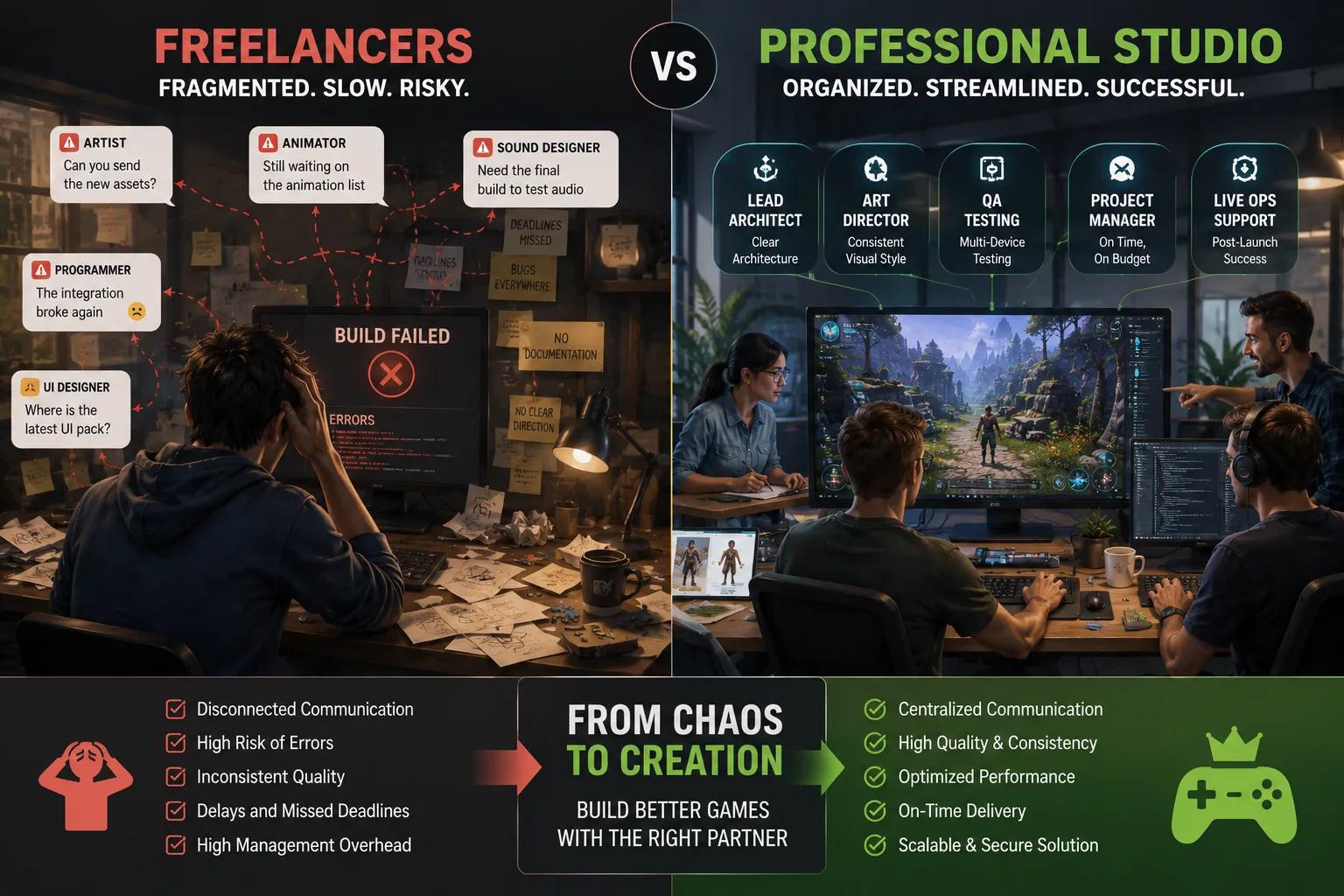
Hiring independent talent seems like an excellent way to keep initial costs low when launching a new interactive project. However, many founders quickly run into a wall when coordinating multiple isolated contractors. If you are currently spending more time managing communication gaps, fixing broken code integration, and chasing down missing assets than actually building your business, it is time to reassess your production strategy.
In this guide, you will learn how to identify the breaking points of a freelance-managed project. We will cover the specific warning signs that indicate your project has outgrown independent contractors, and explain how partnering with a structured team like Cobweb Games protects your investment and ensures a polished market launch.
Key Signs You Need a Game Development Company
You should transition from freelancers to an established game development company if you experience any of the following technical or organizational issues:
Integration Bottlenecks: Code written by one developer constantly breaks when combined with assets created by another.
Communication Management Overload: You spend your entire work week acting as an accidental project manager instead of a strategic founder.
Inconsistent Visual Asset Quality: The user interface, 2D art, and 3D models feel mismatched and lack a unified artistic direction.
Lack of Specialized QA Testing: The game functions on your personal device but crashes frequently during external multi-device testing.
Signs You Have Outgrown Independent Contractors
You Are Acting as an Accidental Project Manager
When you hire separate freelancers for programming, audio, and art, someone has to piece those components together. If you lack a background in technical production, you will quickly find yourself overwhelmed by managing version control, timeline delays, and conflicting feedback loops between contractors.
Broken Code and Integration Nightmares
Independent coders often work in silos. A contract programmer might deliver a clean script for a character movement system, but if it does not integrate with your network engineer's multiplayer lobby framework, the game breaks. Resolving these architectural conflicts without a dedicated lead engineer results in massive technical debt.
Inconsistent Player Experience and Polish
A successful commercial game requires a unified presentation. Freelancers often pull from different stylistic backgrounds. Without an overarching Art Director and UI/UX Designer working under the same roof, your menus, environmental design, and marketing assets will feel disconnected, driving down player retention.
Freelance Contractors vs. Professional Studio Pipelines
Managing an uncoordinated team often leads to unexpected production hurdles. The following breakdown highlights the differences between fragmented freelance management and professional execution.
Freelance Developer Assembly | Professional Game Studio Execution |
Fragmented communication across multiple time zones | Centralized project management and clear milestone updates |
High risk of data loss and poor version control | Secure, unified source control and clean architecture |
Hidden integration costs when combining assets | Seamless pipeline synchronization from art to code |
Basic debugging limited to the contractor's device | Full QA testing across hundreds of real-world devices |
Inconsistent art styles that harm brand identity | Cohesive creative direction from veteran art directors |
Common Mistakes to Avoid
Treating Game Production Like Simple Web Design: Games are complex, real-time interactive systems. Hiring a general software developer instead of a dedicated gaming specialist often results in unoptimized code that drains device battery life.
Neglecting Cross-Platform Optimization: Assuming a game that works on a high-end desktop will automatically scale down to mid-range mobile devices without rigorous optimization adjustments.
Ignoring Long-Term Live Operations: Forgetting that modern games require ongoing server maintenance, security patches, and structural updates well after the initial launch date.
Best Practices
Audit Your Internal Production Time: Calculate exactly how many hours you spend managing contractors. If administrative duties consume more than 20% of your time, transition to an agency model.
Insist on a Central Lead Architect: Ensure your project has a single, authoritative technical lead who oversees the entire codebase to prevent conflicting development styles.
Prioritize Unified Design Documentation: Maintain a comprehensive Game Design Document (GDD) that explicitly outlines technical specifications, visual style guides, and monetization mechanics before production starts.
Why Cobweb Games Is the Right Choice for Your Project
Scaling a game concept past the prototype stage requires an integrated ecosystem of talent. Cobweb Games provides the structural alignment, engineering expertise, and creative vision needed to launch competitive titles. Whether you are building an educational platform, an immersive multiplayer environment, or a mobile title, our unified production pipeline removes the burden of management from your shoulders.
Contact Information
Business Name: Cobweb Games
Address: 580 California Street San Francisco CA 94104
Phone: (855) 773-1064
Email: [email protected]
Website: https://www.cobwebgames.com/
Stop managing fractured workflows and start building a premium interactive experience. Contact the professional team at Cobweb Games today to schedule your strategy session.
Featured Image Suggestion
A side-by-side split concept. On the left side, a stylized, frustrated studio founder sits before a desk full of mismatched puzzle pieces and disconnected chat windows. On the right side, a clean, collaborative development team works smoothly around a single, unified monitor showing a beautifully rendered, polished 3D game environment.
FAQs
1. Why do freelance development teams face integration issues?
Freelancers generally work on isolated tasks without a shared development environment. Without a unifying technical architect, combining individual code submissions frequently causes system conflicts.
2. Is a game development studio more cost-effective than freelancers?
While the initial hourly rate for a studio may appear higher, centralized management, faster development speeds, and reduced bug-fixing cycles often lower the total cost of ownership before launch.
3. How does an agency handle game asset optimization?
Professional studios utilize integrated pipelines where 3D artists work directly alongside technical animators and engine engineers, ensuring assets are optimized for high frame rates and memory limits.
4. Can a studio take over an existing freelance codebase?
Yes. Established agencies typically begin with a comprehensive technical audit of your current repository to patch security vulnerabilities, clean up code architecture, and establish stable code foundations.
5. What security benefits does a company offer over individual contractors?
A professional studio operates under clear non-disclosure agreements, centralized secure repositories, and formal corporate liabilities, heavily reducing the risk of source code leaks or intellectual property theft.