2D vs 3D Animation: Which Fits Your Brand?
Picking between a 2D animation company and a 3D animation company usually starts with the wrong question: which one looks better? The right question is which one fits your product, your budget, and your timeline. 2D and 3D aren't just visual styles, they're different production processes with different costs, different timelines, and different strengths. This guide breaks down where each format wins, what it costs, and how to choose between a 2D animation company and a 3D animation company near you.
Table of Contents
● What Sets 2D and 3D Animation Apart
● Where 2D Animation Wins
● Where 3D Animation Wins
● 2D vs 3D Animation: Quick Comparison
● What Is the Difference Between 2D and 3D Animation?
● Common Mistakes Brands Make When Choosing a Format
● How to Choose a 2D or 3D Animation Company Near You
● Conclusion
What Sets 2D and 3D Animation Apart
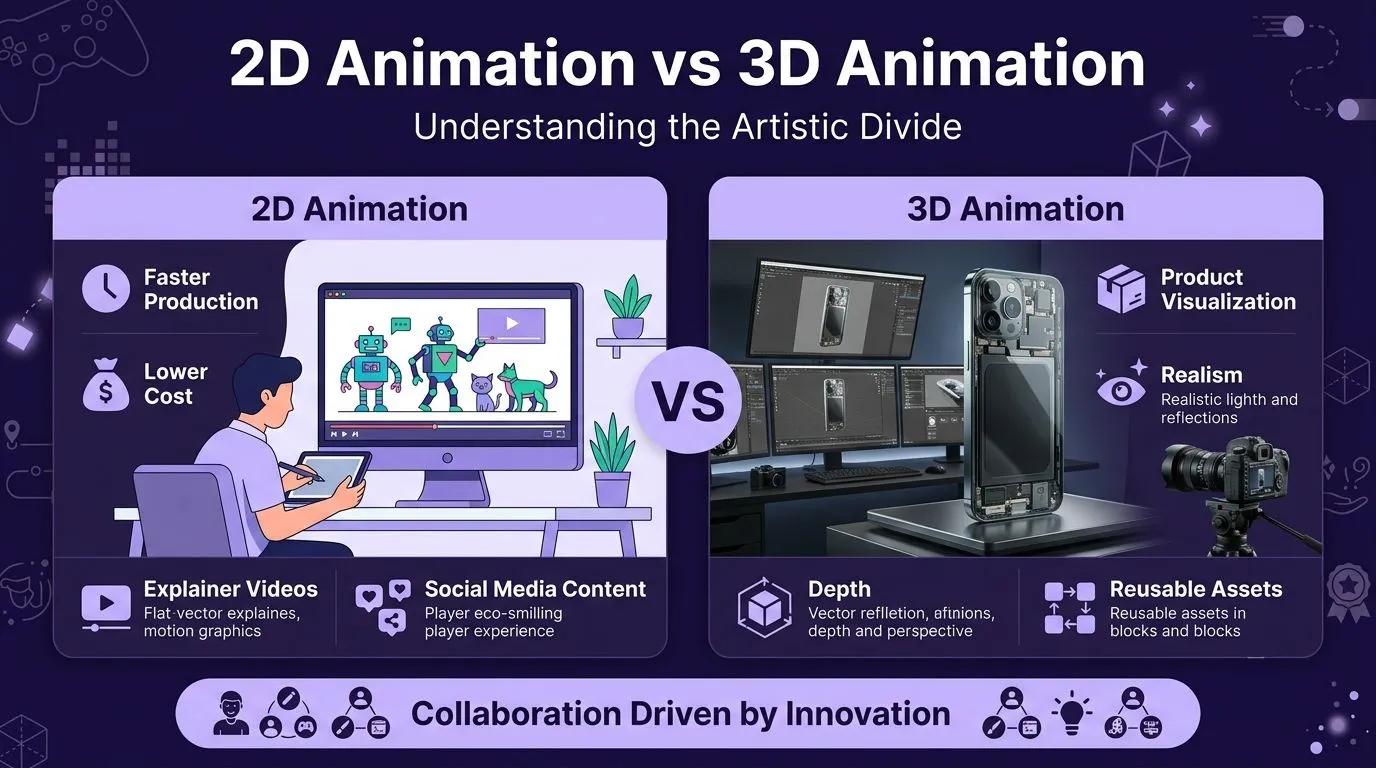
2D animation is drawn or built in a flat plane: characters, icons, and backgrounds move across a two-dimensional space. It's the format behind most explainer videos, app walkthroughs, and social ads. 3D animation builds everything in a modeled, three-dimensional space with lighting, depth, and camera movement, closer to how a physical object or environment would actually look and move.
Where 2D Animation Wins
Faster Turnaround
2D projects move faster because there's no modeling, rigging, or rendering pipeline to build first. A simple explainer can go from script to final video in a few weeks, which matters for product launches and time-sensitive campaigns.
Lower Cost for Most Use Cases
Industry pricing generally puts standard 2D animation in the low thousands to mid five-figures per minute, depending on style and complexity, well below what custom 3D work costs at a comparable quality level. For explainer videos, onboarding content, and social ads, 2D usually delivers the same clarity for less.
Best for Ideas, Not Objects
If you're explaining a workflow, a policy, or a software feature, 2D handles abstraction well. Icons, arrows, and simple character animation can walk a viewer through a concept without needing anything to look physically real.
Where 3D Animation Wins
Showing a Real Product
If your brand sells a physical product, packaging, or equipment, 3D animation can show it from every angle, in any environment, without a physical prototype or a photo shoot. This is where a 3D animation company earns its higher price tag.
Depth and Realism
3D gives you lighting, camera movement, and spatial depth that 2D can't replicate. For architecture, product design, automotive, and anything where realism builds trust, 3D is usually worth the added cost.
Reusability Across Angles and Scenes
Once a 3D model exists, it can be reused in new scenes, new angles, and new campaigns without rebuilding from scratch, which can offset the higher upfront cost over a longer campaign.
2D vs 3D Animation: Quick Comparison
Factor | 2D Animation | 3D Animation |
Typical cost per minute | Low thousands to mid five-figures | Mid five-figures and up, higher for photorealistic work |
Turnaround | Faster, fewer production stages | Slower, requires modeling and rendering |
Best for | Explainers, app demos, social content | Product showcases, architecture, realistic environments |
Reusability | Lower, scenes are mostly custom | Higher, models can be reused in new scenes |
Visual depth | Flat, stylized | Real depth, lighting, and camera movement |
What Is the Difference Between 2D and 3D Animation?
2D animation is created in a flat, two-dimensional space using drawn or vector art. 3D animation is built from modeled objects in a three-dimensional space with lighting and camera depth. 2D is generally faster and more affordable, while 3D offers more realism and works better for showing physical products.
Common Mistakes Brands Make When Choosing a Format
● Choosing 3D for a project that's really about explaining an idea, not showing an object, and paying more for realism nobody needed.
● Choosing 2D for a physical product that needs to be seen from multiple angles, then relying on photos to fill the gap.
● Not asking how the studio's pricing scales with revisions before signing off on a format.
● Picking a format based on trend rather than what the campaign actually needs to communicate.
How to Choose a 2D or 3D Animation Company Near You
● Ask to see work in your industry, not just a general reel, from both 2D and 3D projects.
● Confirm whether the studio handles both formats in-house or subcontracts one of them.
● Get a per-minute cost range in writing before the project starts, since pricing varies widely by studio and complexity.
● Ask how long revisions take and whether future updates reuse existing assets.
Pixel Studios INC provides both 2D and 3D animation for brands across the United States, United Kingdom, and Canada, and works with clients directly rather than through a subcontracted pipeline.
Pixel Studios INC — 195 Cadman Plaza West, One Pierrepont Plaza, 12th Floor, Brooklyn, NY 11201, United States · +1-443-487-0213 · pixelstudiosinc.com
Conclusion
There's no universal right answer between 2D and 3D animation, only the right answer for what you're trying to show. If you're explaining an idea, a process, or a service, a 2D animation company will usually get you there faster and for less. If you're showing a physical product or building something that needs real depth and realism, a 3D animation company is worth the investment. Start with what you need to communicate, and the format usually picks itself.